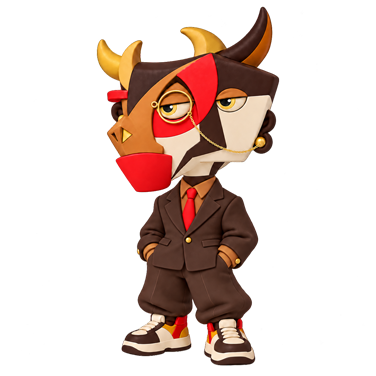
New York Bring people together around the Drakes
21 May 2025 · With support from Solflare and DKS
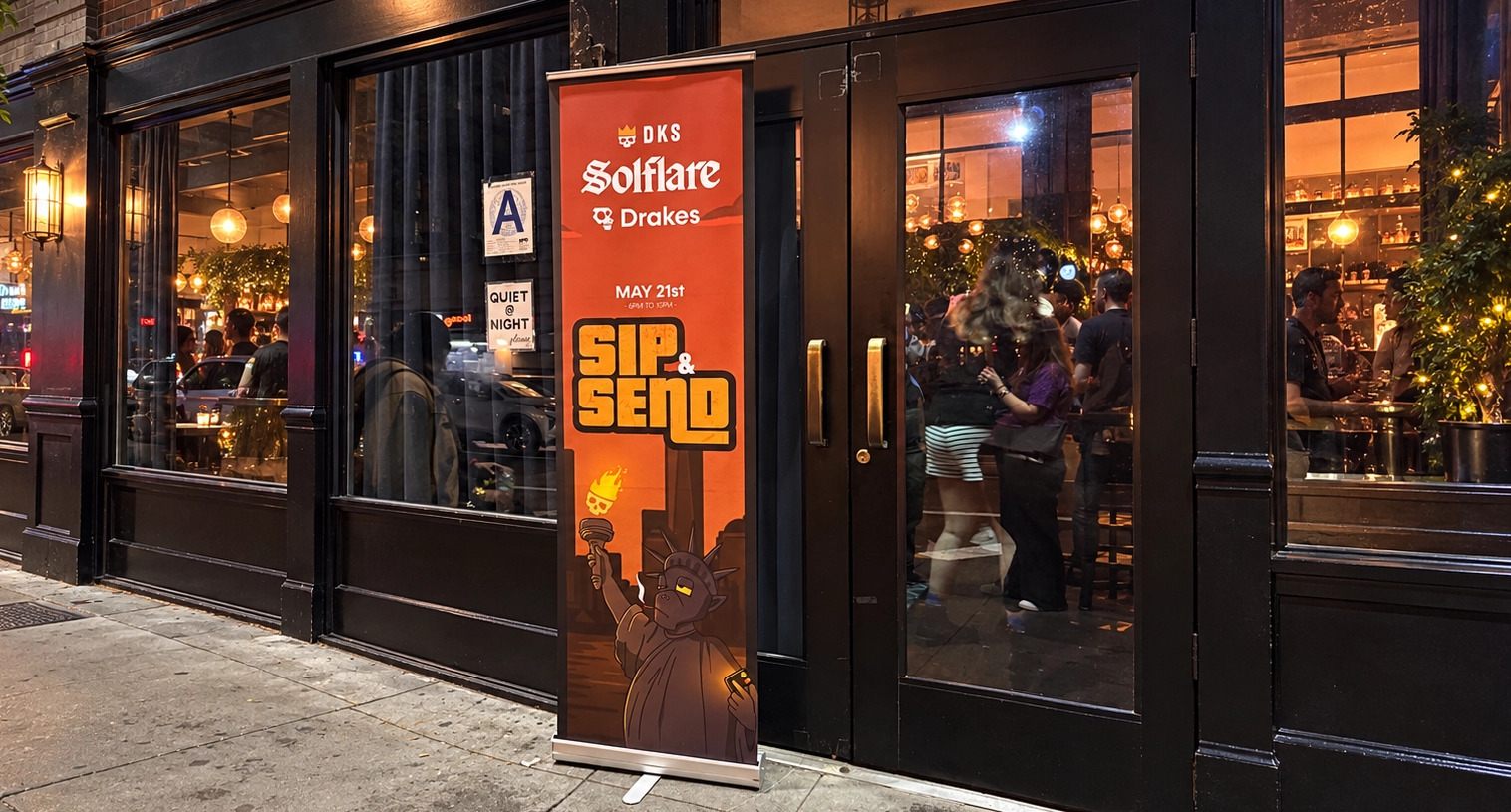
Lucid Drakes co-organised an exhibition in New York, supported by Solflare and DKS. To announce the event, I designed the large promotional display installed outside the venue: the collection’s visual world took its place on the street before visitors even discovered the artworks inside.
Paris — The artworks and the conversation
19 July 2022 · Solana Hacker House · Invited by Exchange Art
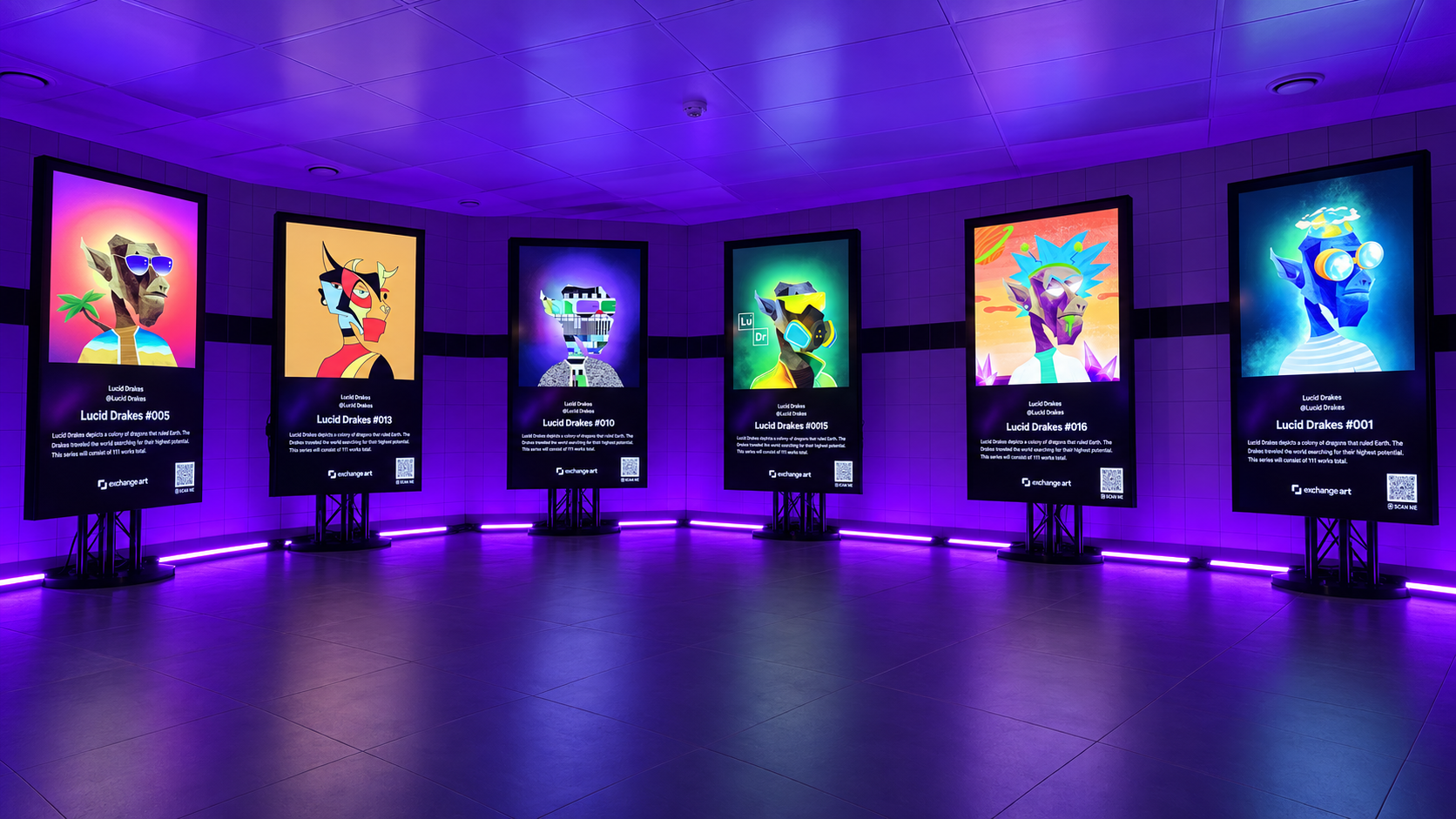
Digital art platform Exchange Art invited me to exhibit my work at the Solana Hacker House in Paris and take part in a Q&A with the audience. A chance to share what the images do not tell on their own: my experiments, the role of textures and the references that feed the characters.
▸ Behind the Drakes — a retrospective interview
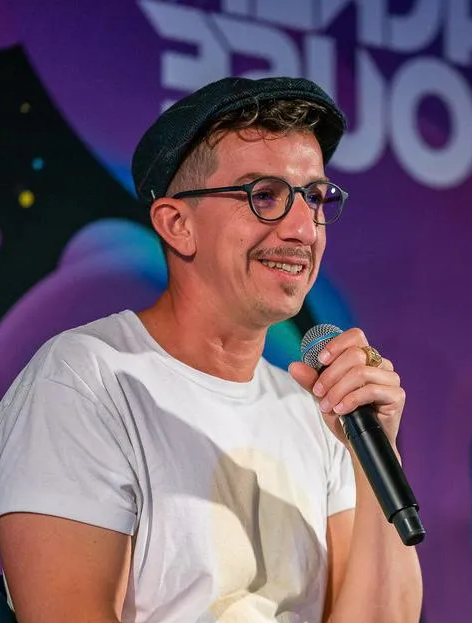
On 19 July 2022, I was invited to exhibit the Lucid Drakes and talk about my work at the Solana Hacker House in Paris. The venue brought artists, builders and startups together for demonstrations, encounters and conversations about the ecosystem. Here is a look back at the experience, through a few questions about how I create.
You describe yourself as a hybrid artist. What does that mean in your work?
I put every technique I have at the service of my creativity: Procreate, Photoshop, 3D, paper collage, then my first experiments with Midjourney. What interests me is exploration and the possibility of taking people on a journey through different references.
Some people see cubism in my characters, others see street art, a cartoon or a video game they remember. In a way, the Drakes are also a map of my personality.
Why dragons?
A dragon can be unsettling, wise, a guardian of treasure. Its meaning changes enormously from one culture to another, and I liked that richness.
At a time when so many collections were multiplying apes or variations on the same animal, I wanted to explore a more mystical creature, one that could carry very different personalities and contradictions.
How does a character begin?
I often start with a technique I want to try, a place or an archetype. With a knight, for example, I might connect ideas of neon, the future or light. It is a bit like a constellation whose stars I join together.
These days, I sometimes say I have a kind of little creative LLM in my head: one idea calls up another, then I explore the possible connections until I find something that surprises me.
For almost a year, I released one drop a week. The idea often started taking shape on Sunday, I looked for references on Monday, then Tuesday and Wednesday evenings were devoted to creating, sometimes until very late. At some point, I would enter a flow state where the possibilities started following one another naturally.
My designer’s eye also guided a lot of those explorations. With a predominantly purple palette, for example, I might look for softness in blues and pinks, then introduce yellow or orange to break it up and draw the eye to a detail.
With so many styles, what holds it all together?
I have a very concrete criterion: I regularly switch the image to black and white to check the contrast. I look for very deep blacks, very bright whites and greys that can connect the two.
I want one of my artworks to be recognisable from a distance, almost through its silhouette and structure before you even see the details.
Textures then add a second layer of interpretation. First you recognise the character, then you can come closer and lose yourself in the details. For me, they serve the character’s story and leave room for imagination.
Is there a Drake you particularly see yourself in?
The cubist, #013.
My godmother introduced me to Picasso and encouraged me to reproduce one of his works when I was younger. She then hung it in her home. While preparing my portfolio almost thirty years later, I rediscovered that connection.
The character has two faces. I can see my own way of looking at things in that: one gaze directed at the problem, and another slightly off to the side, more mischievous, looking for what we have not seen yet.
What has this collection allowed you to build?
A personal visual legacy.
The Lucid Drakes let me explore characters, techniques and ideas that nobody would necessarily have commissioned from me in an agency. Each piece had to appeal to me first and make something resonate.
What surprised me afterwards was seeing people choose very different Drakes and adopt them as avatars. Something deeply personal suddenly became an image someone else could see themselves in.
There are also a lot of hidden things in the Drakes.
Yes. I really like references within references.
Even the collection’s final number, 69, works on several levels. There is obviously the sexual wink, but I also see symmetry and a way of bringing opposites into conversation. I connect it in particular with this idea attributed to Hermes Trismegistus: “As above, so below.” Two things can seem opposed and still echo each other, depending on how you look at them.
That logic continues inside the artworks. I have sometimes hidden texts or poems before painting over them. Some metadata contains links to videos or other references, and I have also used steganography to conceal elements.
That probably comes from my hacking culture: the pleasure of looking for what lies behind what is immediately visible.
You do not need to discover everything for the artwork to work. You can simply be moved by the colours, the proportions or the character. Then come back later and discover a reference, a text or another intention.
I like the idea that an artwork can change slightly as the viewer’s way of seeing evolves.