
I remember conversations at events where people were talking about the next Lucid Drakes drop while I was literally standing beside them, without knowing I was one of its co-founders. It was strange, but it was also proof that something had worked: Lucid Drakes was starting to exist independently of us.
Until then, much of our identity lived quite instinctively in my artworks, the way we communicated on Twitter, the drops, the events and the experiments orbiting the project in the community chat.
Lucid Drakes was becoming the sum of the impressions people held onto when they saw our logo or heard our name.
Turning an intuition into a system
For the website, the first design system was built in Figma. It was easy to share, and comments on the assets made the back-and-forth between France and Canada much simpler.
I wanted something raw and graphic, inspired by neo-brutalism, but with subtle gradients and a very vivid palette, light and dark versions based on simple rules, strong typography and above all a modular system of reusable cards.
I wanted to build a vocabulary, and the instructions to go with it.
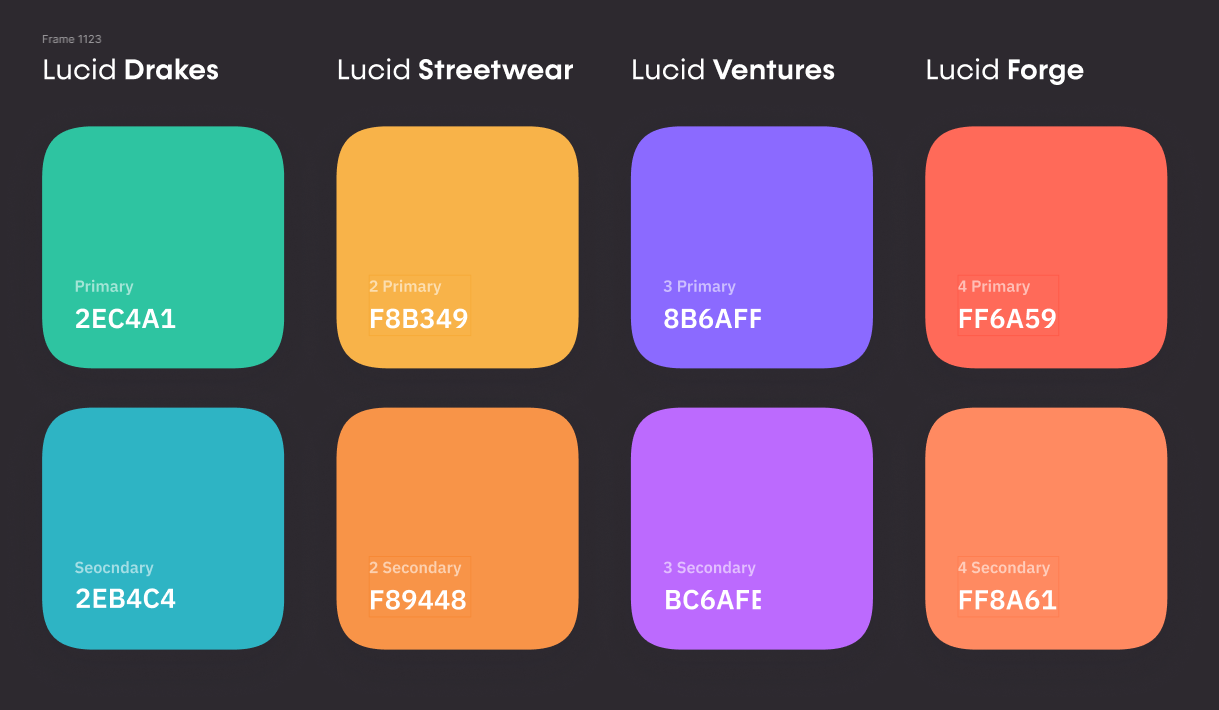
Not all those directions were ultimately rolled out in that form. But imagining them already forced us to answer an interesting question: how far could we extend Lucid Drakes?
Designing to multiply
The future website needed to accommodate extremely different content: artworks, products, announcements, figures, events, experiments and new branches of the project.
Rather than designing every page independently, I built the interface around small components that could be recombined. I drew freely on the logic of Atomic Design: solve the recurring elements first, then use them to assemble more complex structures.
Bento design came naturally. A card could change its size, purpose, content or colour while staying within the same visual language.
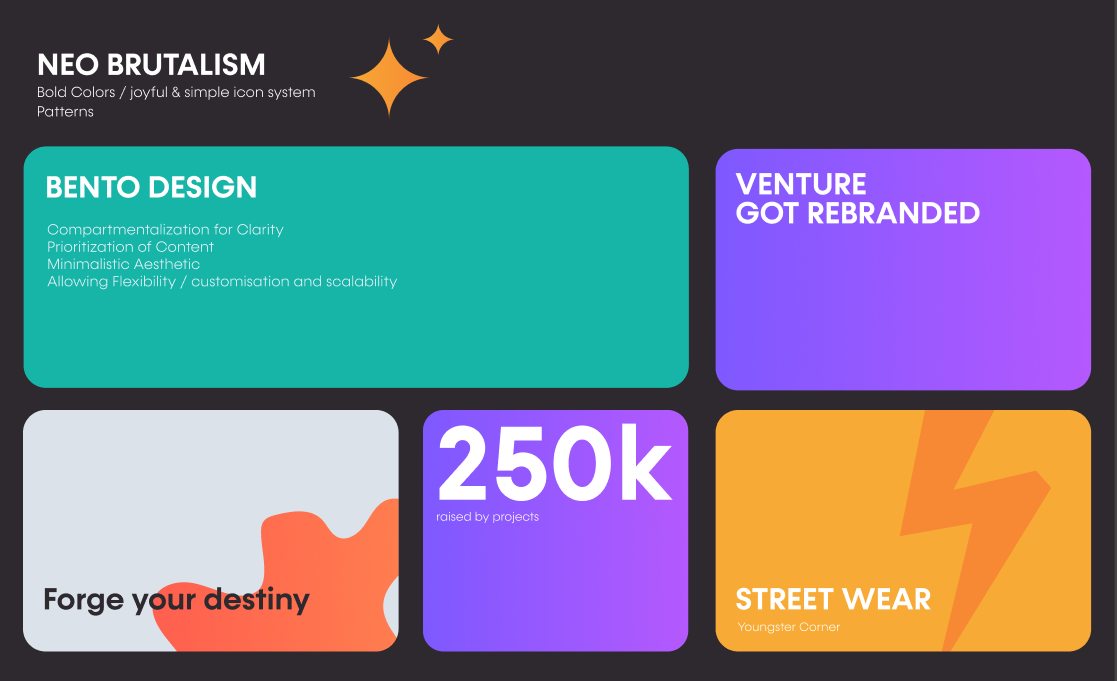
Not a layout. A kit of parts.
Handing over without losing the direction
At that point, I had no desire, and not really the time, to produce every variation.
The drops, family life and my other work on the side were already taking up a lot of time.
So we brought in a graphic designer to develop the system. I gave her the initial Figma file, the assets, the palette, the colour rules, the card system and the interaction principles, while leaving her free to explore within that direction.
She brought something very valuable to the project: rigour. Where my first explorations had been quick and deliberately open, her work made the system much cleaner, more coherent and ready for production.
My role was no longer to produce every element. It was gradually becoming about defining the rules that would allow others to produce new ones.
Learning to delegate and trust people is how you grow!Making the system usable by someone else
The same challenge came up with our community manager. He worked with us part-time and needed to produce our Weekly Report every week, entirely on his own.
We were not going to create a CMS for a newsletter; we wanted to test the format first.
So I prepared self-adjusting components in Figma that he could reuse himself, then recorded a short video breakdown showing how to assemble the elements, edit the content and find his way back to the system’s logic if he got stuck.
The idea was not to teach him everything about Figma. I mainly wanted to leave him a reference: something he could reopen five minutes later or two weeks afterwards and think, “OK, that is how it works.”
And it worked pretty well. After that handover, he could produce his Weekly Reports independently while maintaining the visual coherence of Lucid Drakes.
That short video ended up becoming one of my favourite examples from the project, because it shows a dimension of design that is easy to forget: designing the system is not enough; you also have to design how you pass it on.
If someone needs the designer every time they use the design system, it probably is not quite a system yet.
From the system to the website
Our brand world was born!
I had defined the art direction, visual structure, components and main behaviours in Figma. Implementation was then handed to an external developer. My business partner managed the day-to-day follow-up using all the material we had already prepared.
A few details drifted during implementation, but never enough to undermine the overall direction. Looking back, it was almost another test: the system was coherent enough to survive my absence.
At first, we wanted to show that Lucid Drakes could be much more than a collection of artworks released on Twitter.
For me, the experience mainly taught me something about creative direction: it is about creating enough coherence and cohesion between the people who bring it to life and the people who experience it, rather than making every decision yourself.
www.luciddrakes.xyz