
I built a tool that analyses an X account, turns its data and content into an influence score, and explains the reasoning behind that score. The first account I tested was my own. The result: 65 / 100 Amplifier. Not exactly the result I would have chosen for myself, which is precisely what makes the exercise interesting.
Context
My experience at the Solana Foundation and as co-founder of Lucid Drakes taught me to pay close attention to the brands I collaborate with and the values they stand for. I have never set out to become a major account on X; I am more interested in making a useful, consistent and transparent contribution.
We had already worked on several initiatives with Solflare, one of the long-established non-custodial wallets in the Solana ecosystem, before I joined their ambassador programme in July 2025 to take part in product launch and education campaigns.
I started this project with a very simple need: a tool that could help me better understand my own contribution and improve it.
Interface design
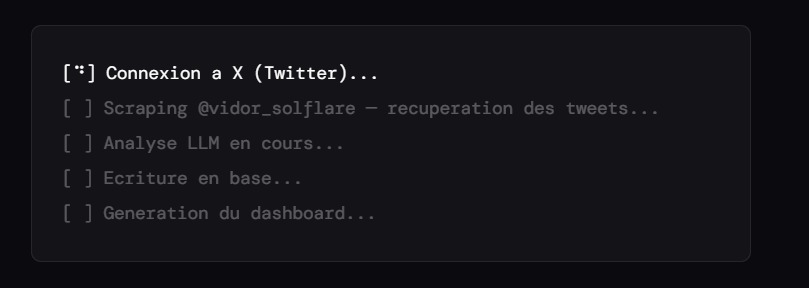
I deliberately kept the interface raw: a dark background, a strict grid, monospace typography and an acid-coloured accent to guide attention. The score dominates the page, while the metrics and recommendations read like an analytical instrument rather than a decorative dashboard.
It works like a terminal. Each stage appears progressively: connection, data retrieval, calculation, analysis and result generation. Once processing is complete, the interface switches to a much more visual dashboard. The idea was simple: make the process visible before presenting a conclusion.
The idea
I moved the scoring criteria out of the code and designed a Brand Brief that lets a brand define its priorities, the topics it wants to highlight, wording to avoid, the expected tone and even its own contributor categories. The same account can now produce different interpretations depending on the scoring framework used.
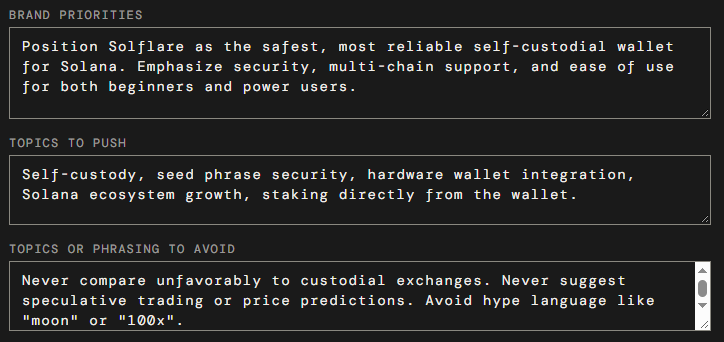
Influence only has value in context. The score is the result. The scoring framework is the product.
How it works
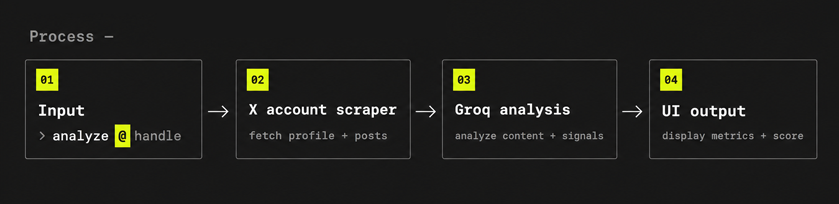
The tool retrieves the account’s profile and recent activity. Objective metrics are calculated in code: posting frequency, engagement, follower-to-following ratio, account age and recent activity. The model only handles what requires interpretation: content, positioning, strengths, weaknesses and recommendations.


Scoring an account is ultimately the easy part. The real question lies elsewhere: who decides what makes a “good” influencer? A crypto brand, a fashion brand and a creative studio are clearly looking for different profiles. The score therefore conceals the perspective of the person making the judgement.
My role
Concept · Product thinking · Art direction · UI design · Architecture · LLM framing ·
I designed the concept, scoring logic, user experience, visual identity and product architecture. Much of the code was produced through vibe coding with Claude Code, under my direction: specifying behaviours, choosing between solutions, testing on real data and iterating on the product.
Stack
- X / Social Data API
- Groq
- Supabase
- JavaScript
- Claude Code
- HTML / CSS
Credits
Djiiz (Sept 2026)